
What Is a Tariff and Why Is Everyone Talking About Them?
Trade wars, rising prices, and retaliating governments. Here is what a tariff actually is, how it reaches your wallet, and why the current situation is the most significant in decades.
The United States average effective tariff rate in 2026 stands at 11%, the highest level since 1943. That single number has reshaped supply chains, triggered retaliation from trading partners across the world, and added an estimated $700 to $1,050 to the annual cost of living for the average American household.
To understand why, you need to understand what a tariff actually is — and how something imposed at a port of entry ends up affecting the price of the things you buy.
What a Tariff Is
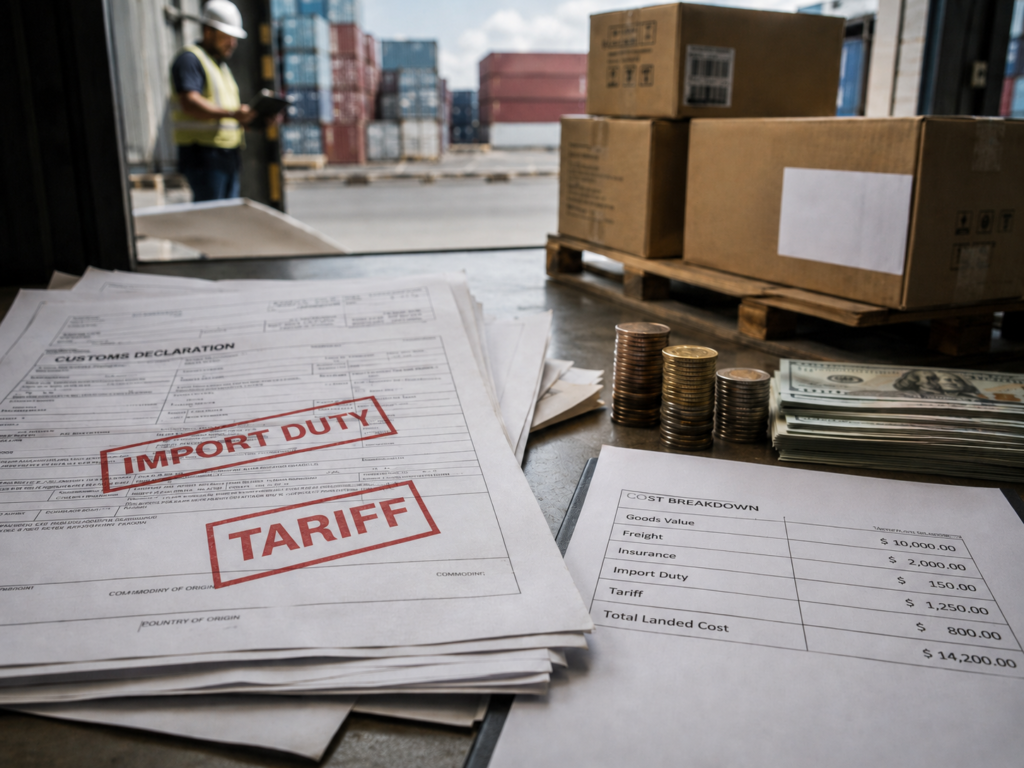
A tariff is a tax on imported goods. When a company brings a product into a country from abroad, it pays the tariff to the customs authority at the border. The rate is usually expressed as a percentage of the product’s value — a 25% tariff on a $1,000 imported television means the importer pays $250 in tax before the product can enter the country.
That cost does not disappear. It is either absorbed by the importing company, reducing its margin, or passed on to the consumer in the form of a higher price. In practice, most of it is passed on. When the US imposed tariffs on Chinese goods in 2025 and 2026, American companies importing those goods paid the tax and raised their prices accordingly. The tariff was collected by the US government, but it was paid, in effect, by American consumers.
This is an important point that often gets lost in political coverage of trade disputes. Tariffs are not paid by foreign countries. They are paid by domestic importers, and ultimately by domestic consumers.
Why Governments Use Them
If tariffs raise prices for domestic consumers, why do governments impose them? There are several reasons, not all of which are economic.
The most traditional argument is protection of domestic industries. If a foreign country can produce steel more cheaply than domestic manufacturers — because of lower wages, government subsidies, or simply greater efficiency — domestic steel producers struggle to compete. A tariff on imported steel raises the price of the foreign product to a level where domestic production can survive. The cost is paid by industries that use steel and by consumers who buy steel-containing products, but the domestic steel industry is preserved.
A second reason is revenue. Tariffs were historically one of the primary sources of government income before income tax became widespread. The United States, for much of the nineteenth century, funded itself largely through tariffs. This rationale is less prominent today but has resurfaced in some current policy arguments.
A third reason is leverage. Imposing or threatening tariffs on a trading partner can be used as a negotiating tool, pressuring the other country to change its own trade practices, currency policy, or other behaviour. This is much of what the current US tariff policy is attempting — using market access as a bargaining chip in negotiations with China, the European Union, and others.
How They Spread
Tariffs rarely remain contained. When one country imposes tariffs, the affected trading partners typically retaliate with tariffs of their own, targeting sectors where they can exert maximum pressure.
The 2026 situation illustrates this clearly. As the US raised tariffs on imports from China, the European Union, Canada, and others, those partners responded with counter-tariffs on US exports. Canadian tariffs targeted American agricultural products. The EU hit American manufacturers. China targeted US technology and energy exports. Each retaliation creates its own set of price increases and disruptions for the retaliating country’s consumers and businesses.
The result is a cycle that tends to raise costs on all sides while reducing the volume of trade overall. Most economists regard this as an inefficient outcome — total global output falls, and consumers in all countries pay more for goods that could have been produced and traded more cheaply before the tariffs existed.
What It Means for Prices
The impact on consumer prices in the US in 2026 is significant but uneven. Yale Budget Lab estimates that current tariff rates translate to an average household cost of around $1,050 per year, assuming tariff costs are fully passed through to consumers. Morningstar forecasts US inflation rising to 2.7% in 2026, partly as a result.
The goods most affected are those imported from high-tariff countries and with limited domestic substitutes. Electronics, clothing, furniture, and certain food products have seen the most visible price increases. Goods that are predominantly domestically produced are less affected.
For businesses, the disruption extends beyond prices. Companies that rely on global supply chains have had to reroute sourcing away from high-tariff origins toward countries covered by free trade agreements or toward domestic production. This restructuring takes time and money, and the transition costs are real even if the long-run position becomes more stable.
Why 2026 Is Different
Trade disputes and tariffs are not new. The US and China have been in various states of trade tension since at least 2018. What makes the current period unusual is the breadth and scale of the measures involved.
An effective tariff rate of 11% across all imports is not targeted at a specific industry or country. It represents a broad shift in US trade policy toward a more protectionist stance that affects virtually every category of imported good and virtually every trading partner. The last time the US operated at this level was the post-war period, before the global trade architecture built around the GATT and later the WTO had fully taken hold.
Whether the policy achieves its stated aims — bringing manufacturing back to the US, reducing trade deficits, generating leverage in negotiations — is a question that will play out over years. What is already visible is the immediate effect: higher prices, retaliation, and a global trading system under more strain than it has been in decades.
Key Takeaways
- A tariff is a tax on imported goods, paid by the importer and typically passed on to consumers as higher prices. Tariffs are not paid by foreign governments.
- The US average effective tariff rate in 2026 is 11%, the highest since 1943, adding an estimated $700 to $1,050 to the average household’s annual costs.
- Governments impose tariffs to protect domestic industries, raise revenue, or use market access as a negotiating tool.
- Tariffs typically trigger retaliation from trading partners, raising costs on both sides and reducing the overall volume of trade.
- The current situation is historically unusual in its breadth — affecting nearly all imported goods from nearly all trading partners, rather than targeting specific industries or countries.